
Imagine a production line that doesn’t just alert you when a machine is close to failure. It understands the risk, checks the production schedule, weighs maintenance options, and recommends a course of action—before an unexpected breakdown brings operations to a halt.
That is the promise of Agentic AIoT: the convergence of agentic artificial intelligence, the Industrial Internet of Things (IIoT), and predictive maintenance. Together, they offer a path from simply monitoring industrial assets to making better, faster, and more coordinated maintenance decisions.
But as machines become more intelligent, an important question emerges: how do we give these systems more autonomy without losing trust, safety, or human oversight?
From connected machines to intelligent action
Traditional industrial IoT has helped manufacturers connect machines, collect sensor data, and monitor equipment in real time. Predictive maintenance takes the next step, using that data to identify patterns that may signal a developing fault.
Agentic AIoT adds another layer: the ability to reason about what to do next. Instead of stopping at a prediction, software agents can assess the situation, consult relevant information, coordinate with other systems, and propose—or, within approved limits, take—action.
Think of it as a progression:
- IIoT connects: Sensors and machines share operational data.
- Predictive maintenance anticipates: Models estimate equipment health and potential failure risk.
- Agentic AI coordinates: Agents use those insights to evaluate options and support decisions.
The goal is not autonomy for its own sake. It is to help people make timely, informed decisions while keeping production, cost, and safety in view.
What might this look like on the factory floor?
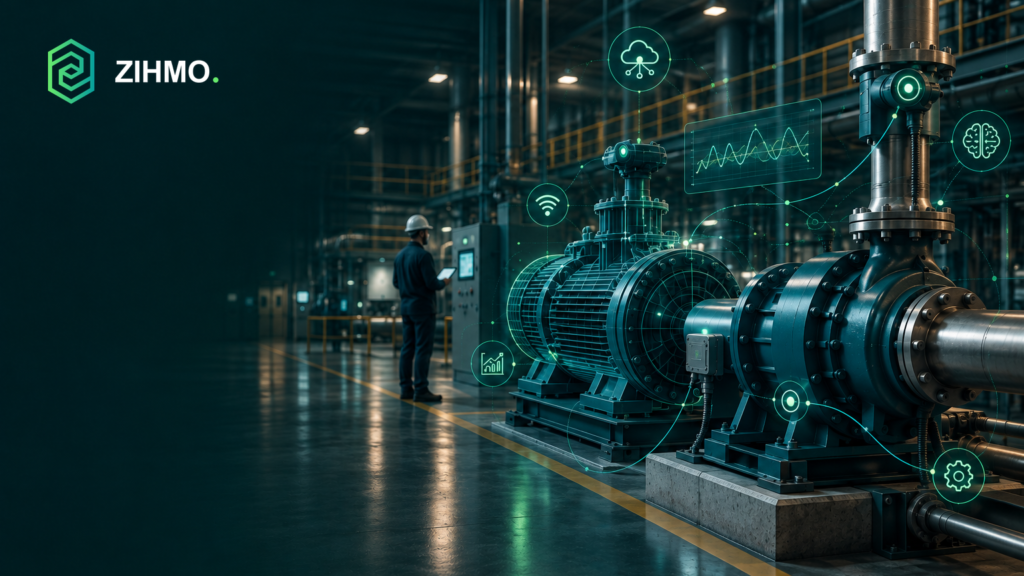
Consider a critical pump whose vibration and temperature readings begin to change. A predictive model detects an unusual pattern and estimates that the pump’s remaining useful life may be declining.
In an Agentic AIoT system, that prediction could set a coordinated workflow in motion:
- A monitoring agent checks the sensor readings and their quality.
- A diagnostic agent combines the anomaly with equipment history and technical documentation.
- A planning agent compares maintenance windows against production priorities and available resources.
- A human operator reviews the recommendation and approves the appropriate action.
Depending on the risk and the organization’s policies, some low-risk steps might be automated. Decisions that affect safety or physical equipment should remain subject to appropriate controls and oversight.
The building blocks of Agentic AIoT
Intelligence at the edge
Industrial environments generate enormous volumes of data, and not every decision can wait for a round trip to the cloud. Edge computing allows some analysis to happen closer to the machines themselves, supporting faster anomaly detection and reducing dependence on constant connectivity.
Models can also be monitored and updated as operating conditions change. However, adapting safely requires care: sensor drift, changing processes, or poor-quality inputs can undermine predictions if they go unnoticed.
Better learning from limited failure data
Thankfully, serious equipment failures are often rare. That is good for operations, but it can make predictive models difficult to train.
Generative approaches, including models such as WGAN-GP, can be explored to synthesize examples of rare failure conditions. Synthetic data is not a substitute for real-world evidence: it needs validation to ensure it reflects plausible behavior and does not introduce misleading patterns.
Knowledge that goes beyond sensor readings
A vibration spike means more when it is understood alongside maintenance records, equipment manuals, operating conditions, and engineering expertise.
Knowledge graphs can help connect these pieces. Large language models may assist in extracting or organizing information from documents, while domain experts validate the results. Combined with time-series data, this context can support diagnostics and remaining useful life estimates.
Human-centered maintenance
Agentic AIoT also fits the broader ambitions of Maintenance 5.0: using advanced technology to support resilient, sustainable, and human-centered operations. The strongest system is not one that removes people from the process, but one that gives them clearer evidence, better options, and meaningful control.
How do the systems communicate?
An intelligent factory relies on several communication layers. No single protocol needs to do everything:
- MQTT provides lightweight publish/subscribe messaging, making it useful for moving sensor data to gateways and applications.
- OPC UA supports interoperable industrial communication and standardized information exchange across equipment and systems.
- DDS enables decentralized, data-centric communication and can support low-latency use cases where appropriate.
- HTTP/REST APIs connect higher-level applications, such as dashboards, maintenance platforms, and scheduling services.
For agents themselves, interoperability adds another dimension. The Model Context Protocol (MCP) provides a standardized way for AI applications to access external tools and data sources. Agent-to-agent communication can use approaches such as an event bus, gRPC, or a dedicated protocol like A2A, depending on the system’s requirements. These are complementary choices—not interchangeable guarantees of safety or reliability.
More autonomy means more responsibility
The same connections that make Agentic AIoT powerful can also expand the attack surface. A compromised sensor, tool, or agent could influence a recommendation—or trigger an unsafe action if controls are weak.
A responsible design should address at least four areas:
- Data and model integrity: Monitor sensor quality, detect suspicious changes, and test models against manipulation and drift.
- Identity and access: Authenticate agents and tools, restrict permissions, and verify the provenance of the context they use.
- Secure communication and infrastructure: Protect data in transit, harden edge devices and containers, and keep software updated.
- Governance and resilience: Log decisions, define safe operating boundaries, require human approval for consequential actions, and plan for faulty or compromised agents.
Security is not an add-on after the agents are deployed. It is part of the architecture from day one.
The road ahead
Agentic AIoT points toward a future where industrial systems do more than report problems: they help teams understand risks, coordinate responses, and act before small issues become costly interruptions.
Getting there will require more than powerful models. It will take reliable data, interoperable systems, rigorous validation, strong security, and people who remain firmly in control.
The opportunity is compelling: smarter maintenance that helps factories become more reliable, more resilient, and better prepared for what comes next.